> ## Documentation Index
> Fetch the complete documentation index at: https://docs.dncscrub.com/llms.txt
> Use this file to discover all available pages before exploring further.
# Reassigned Scrub
> APIs for identifying reassigned phone numbers and maintaining TCPA compliance
# TCPA & Reassigned Numbers
In a number of scenarios the TCPA (Telephone Consumer Protection Act) requires businesses to have consent before calling consumers. When a phone number is reassigned to a new person, your previous consent is no longer valid as consent is tied to an individual, not a specific phone number.
Our Reassigned Authority APIs help you identify reassigned phone numbers to maintain compliance.
## Why Reassigned Number Detection Matters
Calling a reassigned number without the new owner's consent can result in
**TCPA violations** with statutory damages of \$500-\$1,500 per call plus the
consumer can file a private right of action lawsuit.
When a consumer gives you consent to call them, that consent is tied to:
* That specific person
* That specific phone number
If the number is later reassigned to someone else, you no longer have consent to call it.
## Available APIs
Enhanced reassigned number detection with additional data points. Uses both
the FCC Reassigned Number Database plus more frequently updated carrier
deactivation data. Goes further back than the FCC Reassigned Number
Database.
Basic reassigned number data using only the FCC's Reassigned Number
database.
Reassigned number detection based on carrier deactivation data.
## File Formats for SFTP or Web Portal
Batch file processing formats for bulk reassignment checking doing via SFTP or
Web Portal
## How It Works
1. **Store the consent date** when a consumer gives you permission to call
2. **Before calling**, check if the number has been reassigned since that date
3. **If reassigned**, do not call - the number now belongs to someone else
## Example Workflow
```javascript theme={null}
// When consumer provides consent
const consentRecord = {
phoneNumber: "7075276405",
consentDate: "2023-06-15",
consentType: "written",
};
// Before calling, check if reassigned
const response = await fetch(
`https://dataapi.dncscrub.com/v1.5/Data/TCPAAuthority?phoneNumber=${consentRecord.phoneNumber}&date=${consentRecord.consentDate}`,
{
headers: { loginId: "YOUR_API_KEY" },
}
);
const result = await response.json();
if (result.IsReassigned === true) {
console.log("DO NOT CALL - Number has been reassigned");
} else if (result.IsReassigned === false) {
console.log("Safe to call - Number has not been reassigned");
} else {
console.log("Unable to determine - Proceed with caution");
}
```
## Key Response Values
| IsReassigned | Meaning | Action |
| ------------ | -------------------------------------------- | --------------- |
| `true` | Number was reassigned after the consent date | **Do not call** |
| `false` | Number has not been reassigned | Safe to call |
| `null` | Insufficient data to determine | Use caution |
## Additional Information Returned
The TCPA Authority API also returns useful phone number information:
* **Line Type** - Wireless, VoIP, Landline, or Paging
* **Carrier** - Original carrier assignment
* **Location** - City, region, country
* **Timezone** - For calling time compliance
## Example Use Case
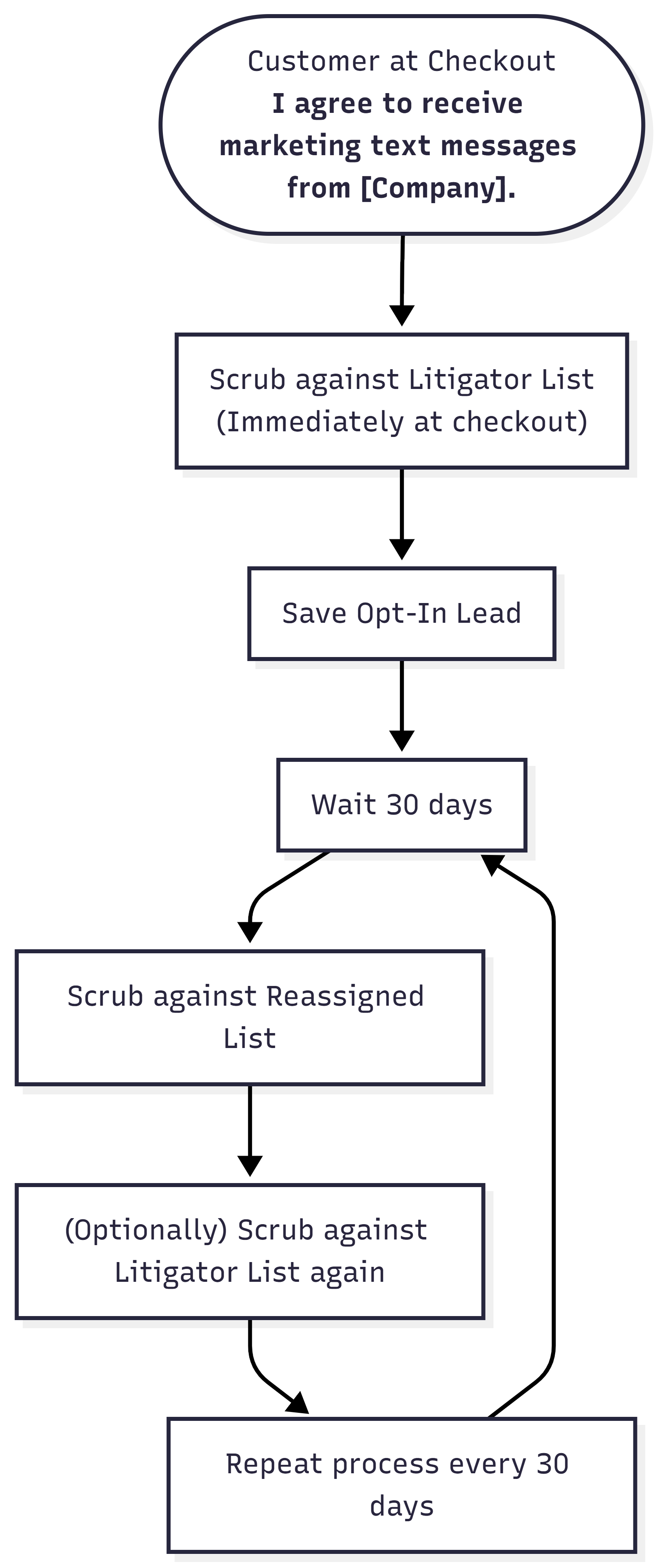
The following diagram illustrates a common workflow for businesses collecting opt-in leads, showing how both the [Litigator API](/api-reference/litigator/overview) and Reassigned Authority API work together to maintain TCPA compliance:
 ### Workflow Summary
1. **At checkout** - When a customer opts in to receive marketing messages, immediately scrub against the Litigator List to avoid known litigators
2. **Save the lead** - Store the opt-in with the consent date
3. **Wait 30 days** - Phone numbers can be reassigned at any time; waiting helps identify reassignments
4. **Scrub against Reassigned List** - Before contacting, check if the number has been reassigned since consent was given
5. **Optional re-check** - Scrub against the Litigator List again (litigator status can change)
6. **Repeat monthly** - Continue this process every 30 days to maintain compliance
### Workflow Summary
1. **At checkout** - When a customer opts in to receive marketing messages, immediately scrub against the Litigator List to avoid known litigators
2. **Save the lead** - Store the opt-in with the consent date
3. **Wait 30 days** - Phone numbers can be reassigned at any time; waiting helps identify reassignments
4. **Scrub against Reassigned List** - Before contacting, check if the number has been reassigned since consent was given
5. **Optional re-check** - Scrub against the Litigator List again (litigator status can change)
6. **Repeat monthly** - Continue this process every 30 days to maintain compliance